Home | Manual | Static Analysis | Playground
Cake - C23 and Beyond
- About
- Web Playground
- Use cases
- Features
- Build
- Installation (optional)
- Running cake
- IDE
- Road map
- Participating
- Cake x CFront
- License
Kernighan & Ritchie, The C Programming Language, 1978:
"C is a general-purpose programming language which features economy of expression, modern control flow and data structures, and a rich set of operators. C is not a "very high level" language, nor a "big" one, and is not specialized to any particular area of application. But its absence of restrictions and its generality make it more convenient and effective for many tasks than supposedly more powerful languages."
"In our experience, C has proven to be a pleasant, expressive, and versatile language for a wide variety of programs. It is easy to learn, and it wears well as one's experience with it grows"
Kernighan & Ritchie, The C Programming Language, Second Edition, 1988:
"As we said in the preface to the first edition, C "wears well as one's experience with it grows." With a decade more experience, we still feel that way."
C is everywhere. From operating systems to embedded devices, from high-performance apps to essential technology, C powers the technology we rely on every day. Timeless, efficient, and universal.
The code that AI now writes runs best where it can be read, verified and trusted. A small language with no hidden machinery. C gives the machine speed, and the human control and platform independence.
About
Cake is a compiler front end written from scratch in C by a human, implementing the C23 language specification and beyond.
It serves as a platform for experimenting with new features, including C2Y language proposals, safety enhancements, and extensions such as literal functions and defer statements.
The current backend generates C89-compatible code, which can be pipelined with existing or old compilers to produce executables.
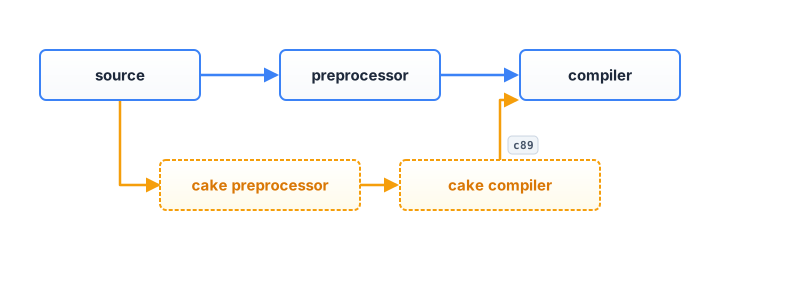
Cake aims to enhance C's safety by providing high-quality warning messages and advanced flow analysis, including object lifetime checks.
Web Playground
This is the best way to try it.
https://cakecc.org/playground.html
Use cases
Note: Cake is still in development and has not yet reached a stable version.
Cake can be used as a static analyzer alongside other compilers. It generates SARIF files, which are recognized by popular IDEs such as Visual Studio and Visual Studio Code, providing a seamless integration.
It can also function as a preprocessor, converting C23 code to C89. This allows developers to use modern or experimental features while targeting compilers that do not yet support the latest language standards.
Cake is also a cross-compiler. For example, on Windows it can use Linux headers and generate GCC-compatible code for Linux, and vice versa. This makes it very useful when developing multiplatform code.
Another use of Cake is as a library to parse source code and build an AST, which can then be used for other purposes; for instance, automatic serialization, automatic documentation and more.
Features
- C23 preprocessor
- C23 syntax analysis
- C23 semantic analysis
- Static object lifetime checks (Extension)
- SARIF output
- Cross compiling
- C89 backend
- Style checker
- AST
- Lots of diagnostics
Build
GitHub https://github.com/thradams/cake
MSVC build instructions
Open the Developer Command Prompt of Visual Studio. Go to the src directory and type
cl build.c && build
This will build cake.exe, then run cake on its own source code.
GCC on Linux build instructions
Go to the src directory and type:
gcc build.c -o build && ./build
Clang on Linux/Windows/macOS build instructions
Go to the src directory and type:
clang build.c -o build && ./build
If you encounter an error such as: fatal error: X11/Xft/Xft.h: No such file or directory
Ubuntu / Debian: sudo apt install libx11-dev libxft-dev
Fedora: sudo dnf install libX11-devel libXft-devel
Arch Linux: sudo pacman -S libx11 libxft
openSUSE:sudo zypper install libX11-devel libXft-devel
These headers are used by the IDE.
Build options
build accepts one optional argument, on any platform:
| Argument | Effect |
|---|---|
| (none) | full build: tools, docs, amalgamated lib.c, cake and the IDE |
fast |
incremental build of cake and the IDE only — skips tools, docs, inner tests and the amalgamation |
full |
build everything with -DTEST, but do not run the test suite |
test |
same as full, then run the test suite |
debug |
build without optimizations and without -DNDEBUG |
For example, to run the tests:
gcc build.c -o build && ./build test
Emscripten build instructions (web)
Emscripten is required.
First do the normal build: besides cake, it generates lib.c, the amalgamated version of the core library, which is what the web build compiles.
Then, in the src directory, type:
emcc -sSTACK_SIZE=8388608 -DMOCKFILES -Wno-multichar lib.c -o web/cakejs.js -s WASM=0 -s EXPORTED_FUNCTIONS="['_CompileText']" -s EXTRA_EXPORTED_RUNTIME_METHODS="['ccall', 'cwrap']"
This generates src/web/cakejs.js, used by src/web/playground.html.
Installation (optional)
Installation is optional. Cake can be built and run directly from the src
directory as shown above, without installing anything. Installing simply
copies the compiler and supporting files into a system directory and updates
the system PATH so the cake command can be executed from any terminal.
Download the installer for your system from the GitHub releases; no source code or compiler is needed.
Versions are installed side by side (cake/<version>); the last one
installed is the one in the PATH.
Windows
Run cake-<version>-setup.exe (it asks for Administrator).
The setup:
- Copies Cake files into
Program Files\cake\<version>(the folder can be changed) - Adds that folder to the system
PATH, removing other Cake versions from it - Registers an uninstaller in Settings > Apps
The installer source is src/tools/win_installer.c; the installed files are
listed in src/tools/win_installer.h.
Linux / macOS
The release has cake-<version>-linux.tar.gz and cake-<version>-macos.tar.gz,
compressed archives (like a zip) with the binaries and install.sh.
curl -L https://github.com/thradams/cake/releases/download/v<version>/cake-<version>-linux.tar.gz | tar xz
cd cake-<version>-linux
sudo ./install.sh
(use macos instead of linux on macOS). If the archive was downloaded
with a browser, extract it with tar xzf cake-<version>-linux.tar.gz
or with a double click, then run sudo ./install.sh inside the folder.
The installer (src/tools/unix_install.sh):
- Copies Cake files into
/usr/local/cake/<version>(usesudo INSTALL_PREFIX=/opt ./install.shfor another prefix) - Adds that folder to the
PATH:/etc/profile.d/cake.shon Linux,/etc/paths.d/cakeon macOS - Creates
uninstall.shin the installation folder
Changes become available in new terminals. To remove:
sudo /usr/local/cake/<version>/uninstall.sh
Notes:
- Linux: built on Ubuntu 22.04 (needs glibc 2.35+).
cakeideneeds the X11/Xft libraries (e.g.sudo apt install libxft2). - macOS: Apple Silicon (arm64) only. The binaries are not signed; if the
archive was downloaded with a browser, macOS blocks them. Allow with
xattr -dr com.apple.quarantine cake-<version>-macosbefore installing (not needed when downloaded withcurl).
Running cake
cake source.c
This writes the C89 output to ./<target>/source.c, where <target> is the platform Cake was built for — for example ./macos_arm64/source.c or ./x64_msvc/source.c. -target=<name> selects another platform; see the Manual for the full option list.
IDE
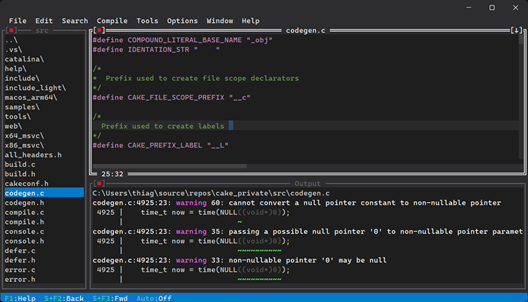
The Cake IDE was developed with the help of AI tools. It has now been adopted as part of the Cake project and will be maintained alongside the rest of the codebase. Over time, the IDE code will be reviewed, refined, and gradually humanized as the project evolves.
The IDE works in macOS, Windows and Linux. Its purpose is to make Cake easier to use: open a file or a project, press Build, and the whole pipeline — Cake's C89 output, the external compiler, the debugger — is set up and driven from one place, with no command lines to remember. It is very useful to visualize and remove warnings: Cake's diagnostics show up in the Output window and jump straight to the offending line.
It is also how Cake itself is developed and debugged. The src/cakeprj.cakeproj
project builds the compiler with the same process any other project uses: Cake
translates the sources to C89, an External Tool (gcc, clang or cl) links the
generated code, and the built-in debugger (lldb / cdb) runs the result. Opening
that project is the quickest way to step through the compiler while it compiles
a sample.
See IDE Manual
Road map
- Making it usable as a C89 backend, and fixes
- Reaching a stable release
Participating
You can contribute by trying out cake, reporting bugs, and giving feedback.
Have a suggestion for C?
DISCORD SERVER
Cake x CFront
CFront was the first C++ compiler, designed to translate C++ source code into C. Initially compatible with C89, it diverged as the C and C++ languages evolved independently.
Cake maintains alignment with the standard specifications and ongoing development of C, ensuring full compatibility.
The compiler introduces extensions that preserve the fundamental design of C while supporting experimentation and open contributions to the language's evolution.
License
Cake uses the same license as GCC: GPLv3.